
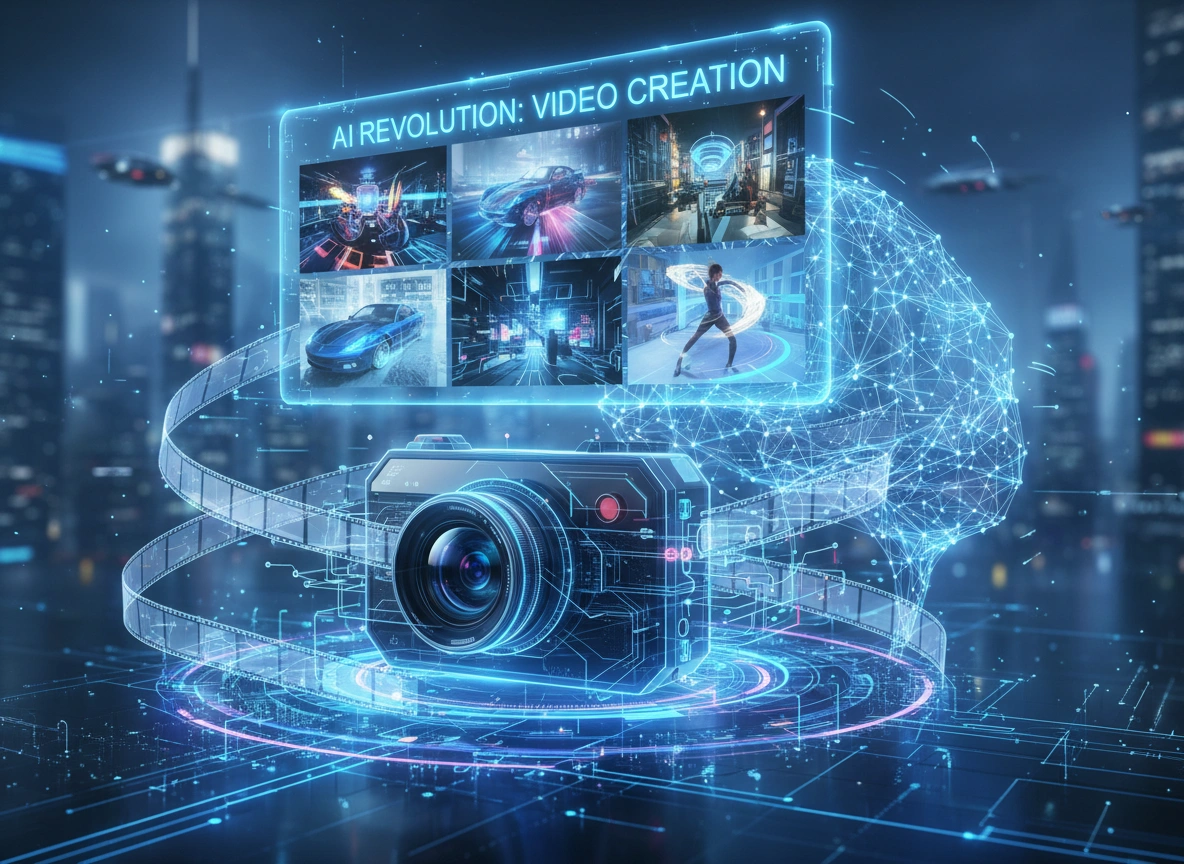
Video has become the dominant medium for communication, entertainment, and marketing. From short-form social clips to feature-length films, the demand for high-quality video content is immense. Meeting this demand traditionally required significant time, resources, and technical skill. Today, artificial intelligence is rewriting the rules of video production, making it faster, more efficient, and more accessible than ever before. AI is not just an assistant; it is a creative partner that is fundamentally transforming every stage of the video creation lifecycle.
This article explores the profound impact of AI on video creation. We will examine the specific technologies driving this change, highlight their applications across various industries, and consider both the benefits and challenges of this ongoing revolution.
The AI Engine Behind Modern Video Production
At its core, the AI revolution in video is powered by machine learning, computer vision, and natural language processing (NLP). These technologies enable software to understand, interpret, and generate video content in ways that were once purely in the realm of human expertise. This has led to the development of powerful tools that automate and enhance the entire production process.
Automating the Pre-Production Grind
Pre-production, which includes scripting, storyboarding, and planning, has always been a labor-intensive phase. AI is streamlining these tasks, freeing up creators to focus on the bigger picture.
- AI-Powered Scriptwriting: Tools using large language models (LLMs) can now generate script drafts, character dialogues, and even entire story concepts based on simple prompts. While not a replacement for human writers, these tools serve as powerful brainstorming aids, helping to overcome writer’s block and accelerate the initial creative process.
- Automated Storyboarding: Instead of manually drawing each scene, creators can use AI to generate storyboards. By inputting a script or scene description, AI tools can produce visual representations, complete with suggested camera angles and character placements. This allows for rapid visualization and iteration before a single frame is shot.
Redefining Production and Editing
The production and post-production phases are where AI’s impact is most visible. Complex editing tasks that once took hours or days can now be completed in minutes, democratizing professional-level video creation.
- Intelligent Editing: AI-powered video editors can analyze raw footage to automatically identify the best takes, remove filler words or long pauses, and even create a rough cut of a video. For example, text-based video editing allows creators to edit video simply by editing a transcribed text document. Deleting a sentence in the transcript removes the corresponding video clip, making the process intuitive and incredibly fast.
- Enhanced Audio Processing: Poor audio can ruin a great video. AI tools excel at audio enhancement, capable of removing background noise, balancing volume levels, and even cloning a person’s voice to correct misspoken words or add new lines without re-recording. This technology ensures crystal-clear sound, a critical component of professional video.
- Advanced Color Correction and Grading: Setting the right mood through color is an art form. AI can analyze footage and automatically apply color correction to balance shots filmed under different lighting conditions. It can also suggest or apply creative color grades that match the style of a famous film or a specific aesthetic, ensuring visual consistency with minimal effort.
The New Frontier of Visual Effects and Animation
Visual effects (VFX) and animation have historically been reserved for big-budget productions. AI is breaking down these barriers, offering sophisticated capabilities to a wider range of creators.
- Generative Video: The most groundbreaking development is generative video, where AI creates entirely new video clips from text or image prompts. Technologies like text-to-video models can produce realistic or stylized scenes, animated characters, and dynamic backgrounds from scratch. This opens up limitless creative possibilities for marketers, educators, and independent filmmakers.
- Realistic Digital Avatars: AI can create photorealistic digital avatars that can speak and gesture naturally. These “digital humans” can be used as virtual presenters in corporate training videos, news anchors, or brand ambassadors in marketing campaigns, reducing the need for on-camera talent and complex studio setups.
- Simplified VFX: Tasks like rotoscoping (isolating objects from their background), object removal, and motion tracking are being automated with remarkable precision. What once required painstaking frame-by-frame work can now be accomplished with a few clicks, integrating special effects seamlessly into live-action footage.
AI’s Transformative Role Across Industries
The applications of AI in video creation are not confined to Hollywood. Businesses, educators, and marketers are all leveraging these technologies to communicate more effectively.
Marketing and Advertising
In marketing, speed and personalization are key. AI enables brands to create customized video ads at scale. An e-commerce company can use AI to generate thousands of product video variations, each tailored to a specific demographic with different visuals, music, and calls-to-action. This level of personalization leads to higher engagement and conversion rates.
Education and Corporate Training
AI is making educational content more engaging and accessible. Instructors can use AI-powered tools to quickly turn lecture notes into animated explainer videos. Digital avatars can deliver training modules in multiple languages, providing a consistent and scalable learning experience for global workforces. This reduces production costs while improving knowledge retention.
Entertainment and Media
The entertainment industry is using AI to push creative boundaries and improve efficiency. AI helps in everything from de-aging actors in films to creating vast, computer-generated worlds for television series. Independent creators on platforms like YouTube can now produce content with production values that rival those of established studios, leveling the playing field.
Benefits and Challenges of the AI Revolution
The integration of AI into video creation brings a host of advantages, but it also presents new challenges that must be addressed.
Key Benefits
- Increased Efficiency: AI automates repetitive and time-consuming tasks, dramatically reducing production timelines.
- Lower Costs: By minimizing the need for expensive equipment, large crews, and extensive manual labor, AI makes video production more affordable.
- Democratization of Creativity: Powerful tools are now accessible to individuals and small businesses, not just large corporations.
- Enhanced Creativity: AI acts as a creative catalyst, offering new ideas and capabilities that expand the artistic possibilities for creators.
Overcoming the Hurdles
- Ethical Concerns: The rise of deepfakes and AI-generated misinformation is a significant concern. Establishing clear ethical guidelines and developing robust detection technologies is crucial for maintaining trust.
- Authenticity and the Human Touch: There is a risk that over-reliance on AI could lead to generic, soulless content. The unique perspective and emotional intelligence of human creators remain irreplaceable for telling compelling stories.
- The Learning Curve: While AI tools simplify many processes, mastering them to achieve high-quality results still requires skill and artistic sensibility.
- Computational Demands: Training and running advanced AI models require significant computing power, which can be a barrier for some users.
The Future is Collaborative
The future of video creation lies in a collaborative partnership between human creativity and artificial intelligence. AI will continue to evolve, offering even more sophisticated automation and generative capabilities. We can expect to see AI that can direct entire scenes, suggest narrative improvements, and generate fully interactive video experiences in real-time.
However, the core of compelling video will always be storytelling, emotion, and a unique point of view—qualities that are inherently human. AI is not here to replace creators but to empower them. By handling the technical heavy lifting and providing new creative avenues, artificial intelligence is setting the stage for a new golden age of video, where anyone with a story to tell has the power to bring it to life.
Please click here for more info
